
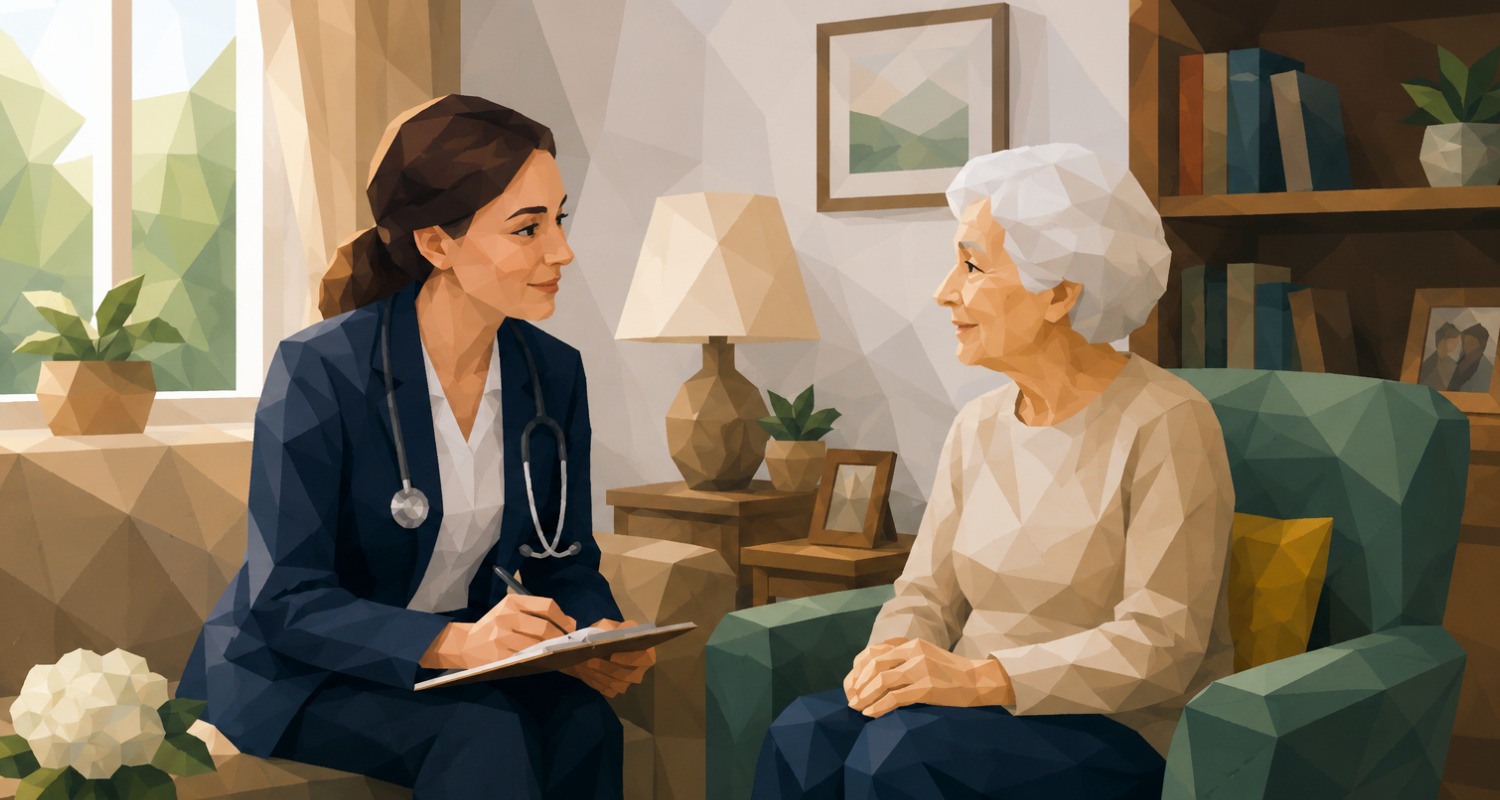
Dr Loredana Kent on how a private GP review at home can offer older patients time, context and more personal care.
A person’s home can tell a doctor things a clinic room never could. It can show whether the stairs have become harder to manage, whether a favourite chair has become the centre of the day, whether family members are taking on more responsibility, or whether the patient’s greatest wish is simply to stay comfortable in the place they know best.
For older patients, these details matter.
Health is rarely separate from daily life, independence, family support and personal priorities. A concern about mobility may also be a concern about confidence. A medication review may also be about whether someone can manage safely on their own. A conversation about symptoms may lead to a deeper discussion about what the patient wants life to look like now.

Dr Loredana Kent
Dr Kent has a special interest in caring for older patients, with experience across elderly care, frailty, rehabilitation medicine, nursing home care and palliative care.
Dr Loredana Kent’s interest in this area began before her GP training. “Even before medical school, I did some volunteering in a nursing home,” she says. “I also grew up being very close to my grandparents, so I think I naturally understood some of the challenges of ageing.”
That early interest continued through her medical career. While at medical school, Dr Kent worked as a domiciliary carer, supporting people in their own homes. During her hospital training, she gained experience across elderly care wards, acute frailty services and rehabilitation medicine. She later completed a diploma in geriatric medicine during her GP training to build on that clinical experience. Today, she also works in an NHS nursing home and palliative care role.
For Dr Kent, this experience has reinforced the importance of looking at the whole person, not one concern in isolation.
“I liked that it was a holistic specialty,” she says. “You cannot look at one problem in isolation.”
As the UK population ages, this wider view is becoming increasingly important. The number of people aged 85 and over in the UK was 1.75 million in mid-2024 and is projected to double to 3.6 million by mid-2049, according to the Office for National Statistics.
But older patients are never just population figures. Behind every statistic is a person with routines, preferences, worries, relationships and a life story that does not always fit neatly into a standard appointment.
Why Older Patients Need A Wider View
Older patients do not always need more tests. Often, they need the right conversation.
Dr Kent says one of the most important parts of caring for older patients is finding out what matters to them now.
“People really vary in how much they want investigated,” she explains. “Some people may say, ‘I just want to be pain-free. I just want my symptoms controlled. I just want to stay at home.’ Other patients, even in their 90s, may say, ‘I want to find out what is causing my symptoms.’ It varies so much from person to person.”
That is why a GP review for an older person should not be treated as a fixed checklist. It should be guided by the patient’s health, their priorities, their family situation and the doctor’s clinical judgement.
For one person, the focus may be mobility and falls. For another, it may be medication. For someone else, it may be memory, sleep, mood, pain, continence, care support or future health wishes.
The value is in having enough time to look at the person properly.
What A Home Visit Can Show
A clinic appointment can tell a doctor a lot. A home visit can sometimes tell them more.
Dr Kent remembers visiting a 96-year-old man whose garden became central to the conversation.
“He had a beautiful garden,” she says. “His priority was to be at home so he could go and sit out in the garden. He was not gardening anymore, but you gain that information.”
On another visit, she met a man in his 80s with Parkinson’s. At home, she noticed academic papers around him. He had spent his life working on malaria research and had written a book on the subject.
“I would never have known that if I had seen him in a clinical setting,” she says. “You really see the person when they are at home, in their own context.”
That is the human value of a home visit. The patient is not reduced to a condition, a prescription list or a short appointment slot. The doctor can see the life around the medical concern.
There are practical details too. At home, a GP may see how easily someone moves around, whether they have handrails, whether they are using the stairs, whether they have a stairlift, what chair they sit in and what support is already around them.
“It is often practical things,” Dr Kent says. “Simple things like that can make a big difference.”
Mobility, Falls And Confidence
Mobility is one of the clearest areas where a home review may help.
Dr Kent says concerns about mobility can be an important marker that someone may be finding daily life harder. That may include fear of falling, near falls or actual falls. It may also include finding it harder to manage at home or struggling more with day-to-day tasks.
Falls are a major issue in older people’s health. NICE says around a third of people aged 65 and over, and around half of people aged 80 and over, fall at least once a year. NICE also notes that falls can lead to distress, pain, injury, loss of confidence, loss of independence and mortality.
A GP review at home can help look at what may be contributing to reduced mobility. This may include pain, dizziness, medication, muscle weakness, long-term conditions or home setup. Where appropriate, the doctor may suggest further support, such as physiotherapy, occupational therapy or additional tests.
Medication Review And Reducing Burden
Medication is another important part of older patients’ care.
“A lot of people will accumulate lots and lots of medications as time goes on,” Dr Kent says.
A review can help assess whether medication remains suitable, whether it is manageable and whether the overall burden can be reduced where clinically appropriate.
This does not mean stopping medication casually. Medication changes should always be considered carefully, especially where a patient has specialists involved or an existing NHS GP managing ongoing conditions.
A GP-led review can ask whether the patient is still benefiting from each medication, whether side effects are an issue and whether the routine is manageable day to day. It may also consider whether practical support, such as a blister pack or dosette box, could make medication easier to manage.
For older patients, the practical side matters. A medication plan is only helpful if the patient can follow it safely and consistently.
Supporting Families As Well As Patients
Care for older patients often involves the family too.
Dr Kent says that in many consultations, the relative’s perspective is central. Sometimes the older person is less worried than the family member caring for them.
“Some of the time, it is not the older person who has the most concerns,” Dr Kent says. “At the point we review a patient, it can highlight how much responsibility a family is holding.”
Relatives may be worried about falls, memory, medication, safety at home or whether their loved one is coping. A GP review at home can help bring those concerns into the open, while giving the doctor a fuller view of the patient’s health, home life and support around them.
This matters because many relatives gradually become carers without fully realising it.
“I think a lot of families can become carers over time without realising it,” Dr Kent says. “Suddenly, they take on much more responsibility.”
That responsibility can affect the whole family. A daughter may start managing appointments. A son may begin checking medication. A spouse may quietly take on more physical care. Over time, the relationship can shift.
Age UK reported in 2025 that 2.1 million carers are aged 65 and over, with 420,000 aged 80 and above.
For families, a GP home visit can offer reassurance and clarity. It gives relatives a chance to share concerns, where the patient agrees, and helps the doctor build a fuller picture of what is happening at home. Most families do not want to take over. They want to know their loved one is being properly supported.
Why Continuity Matters More As We Age
Continuity can be especially important for older patients.
“It can be really hard when you see someone who is elderly as a one-off because you do not know what is normal for them and what is not,” Dr Kent says. “Whereas if you know a patient and you see them regularly, then you can really notice if they are having any changes in their memory, in their physical health.”
A doctor who knows the patient may notice subtle changes. A slight decline in mobility. A change in memory. A shift in mood. A new concern from the family. A medication issue. A change in how the patient speaks about their priorities.
Continuity also helps the patient feel known. They do not have to repeat their full story every time. Their doctor understands their medical history, but also their home life, support network and personal wishes.
As Dr Kent puts it, patients want to be known “as a person, rather than as a list of health issues, diseases or problems.”
What A Doctorcall Older Person’s Review May Include
A Doctorcall GP review at home for an older patient is not intended to be a rigid screening package.
Depending on the patient’s needs, it may include discussion or assessment of:
- Current health concerns
- Past medical history
- Medication
- Mobility and falls risk
- Memory concerns
- Mood and sleep
- Pain affecting daily life
- Bladder or bowel concerns
- Bone health where relevant
- Care and support at home
- Family concerns
- Future health wishes where appropriate
- Further tests, referrals or follow-up appointments where needed
The review is guided by the doctor’s clinical judgement and the patient’s own priorities.
It may be especially relevant for people over 70, although some younger patients with frailty, multiple health conditions or changing care needs may also benefit. Dr Kent notes that age alone does not tell the full story. Some people in their 60s may need more support, while some people in their 70s or 80s remain active and independent.
The better question is not simply “How old is this person?”
It is “What support do they need now?”
Seeing The Whole Person
For Dr Kent, good care for older patients comes back to one simple idea.
“Most people want to feel heard,” she says.
They want someone to understand their concerns, but also the context of those concerns. They want a plan that feels collaborative. They want to feel that their doctor knows them as a person.
That is why home-based GP care can be so valuable for older patients and their families. It gives the doctor a fuller view of the patient’s health, their daily life and the people around them.
“As a doctor, it is so valuable to have time and space for someone to talk about what is important to them,” Dr Kent says. “It is about being able to sit down and have a conversation.”
It is not just about treating a problem.
It is about understanding the person living with it.
Speak To Doctorcall
Doctorcall provides private GP home visits and ongoing GP care for patients who would benefit from medical support at home.
To arrange a private GP home visit or discuss whether an older person’s GP review may be suitable, contact Doctorcall.
Arrange A Private GP Review At Home
If you are concerned about an older parent, relative or loved one, Doctorcall can arrange a private GP visit at home.
A doctor can review current concerns, medication, mobility, memory, family worries and wider care needs, then advise on appropriate next steps.